First exam · May 4, 2027
A brand-new exam. No past papers. No one to tell you what “good” looks like.
TeensMBA is the complete self-study course for the AP® Business with Personal Finance exam: 31 animated lectures built topic-by-topic on the official course framework, 744 original practice questions, and free-response coaching that scores your writing the way readers will. If the course feels like fog, this is the lighthouse.
- Lectures
- 31 topics · 326 minutes
- Practice
- 744 questions · 31 free-response tasks
- Coverage
- All 5 units, every learning objective
- Price
- Unit 1 free · Pro $300/year
Why this exam feels harder to prepare for than the others
It has never been given
The first administration is May 2027. There are no released exams, no score reports, no “what came up last year”. Students and teachers are starting from the framework alone.
Forty percent is writing
Four free-response questions carry 40% of the score, and one of them is about a business project you build yourself. Multiple-choice drilling alone will not get you there.
Business is taught as vocabulary
Most study material lists terms. The exam asks you to apply them to a scenario with numbers — margins, cash, hiring, pricing — and to defend a decision.
What TeensMBA does about it
1 · Built on the official framework, line by line
Every lecture, question and rubric is written to the published learning objectives and essential-knowledge statements. Each practice question is tagged with the exact code it tests, and each topic page shows you which statements are covered — so nothing on the framework is left to chance.
2 · One business story, start to finish
You follow Bean & Brew from a 12-seat coffee shop to a 40-store chain. Pricing, hiring, cash flow, KPIs and strategy all happen to the same company, so concepts connect instead of piling up. Short real-company cases show the same idea at global scale.
3 · Concept → case → quiz → free response → feedback
Each topic runs the full loop: a 10-minute lecture, a mid-lecture check, a 24-question practice set with explanations, then a free-response task scored row by row. You do not move on by watching — you move on by writing.
4 · Free-response coaching, not just a score
Each part of your answer gets 0 or 1, the way readers score, with the sentence that earned or lost the point quoted back to you — and a rewrite of your sentence that would have earned it. Then a five-minute drill to fix the habit.
5 · Reviewed by people who teach it and people who do it
With no established textbook for this course yet, review matters. Lectures and rubrics are checked by teachers running the course, and the business content by MBA-trained executives from global companies — so what you learn is both exam-correct and true to how business actually works.
6 · Exam-day realism
Timed 60-question mocks at the real pace, scored by unit. A dashboard that counts down to May 4 and tells you how many topics a week keeps you on track, with six weeks held back for review.
How one topic works
About 45 minutes from first slide to scored writing.
| Watch · 10 min | Animated lecture through the Bean & Brew story plus a real-company mini-case. One quick check halfway through. |
|---|---|
| Read · 3 min | Full transcript in English and Korean, and the list of framework statements this topic is tested on. |
| Practise · 20 min | 24 questions in stimulus sets. Check a set, read why each answer is right or wrong, retry or move on. |
| Write · 13 min | An exam-style free-response task with the real suggested time on the clock. |
| Fix · 5 min | Row-by-row score, coaching feedback, a rewritten sentence, and a short drill. Weak spots go straight to your dashboard. |
What it looks like
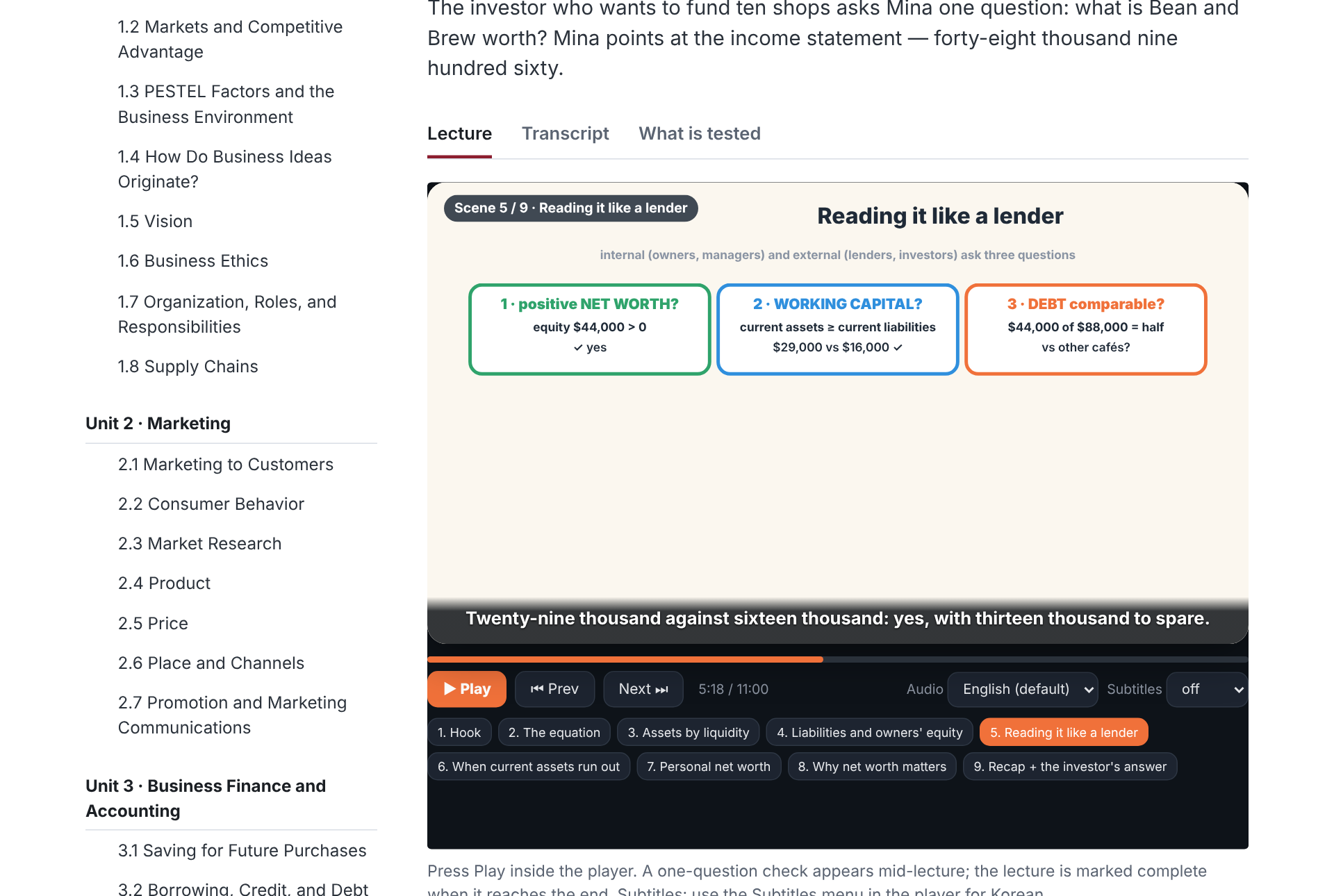
Animated lecture
Every concept is shown as a decision with numbers — here, a lender reading Bean & Brew's balance sheet. English narration, Korean subtitles, scene-by-scene navigation.
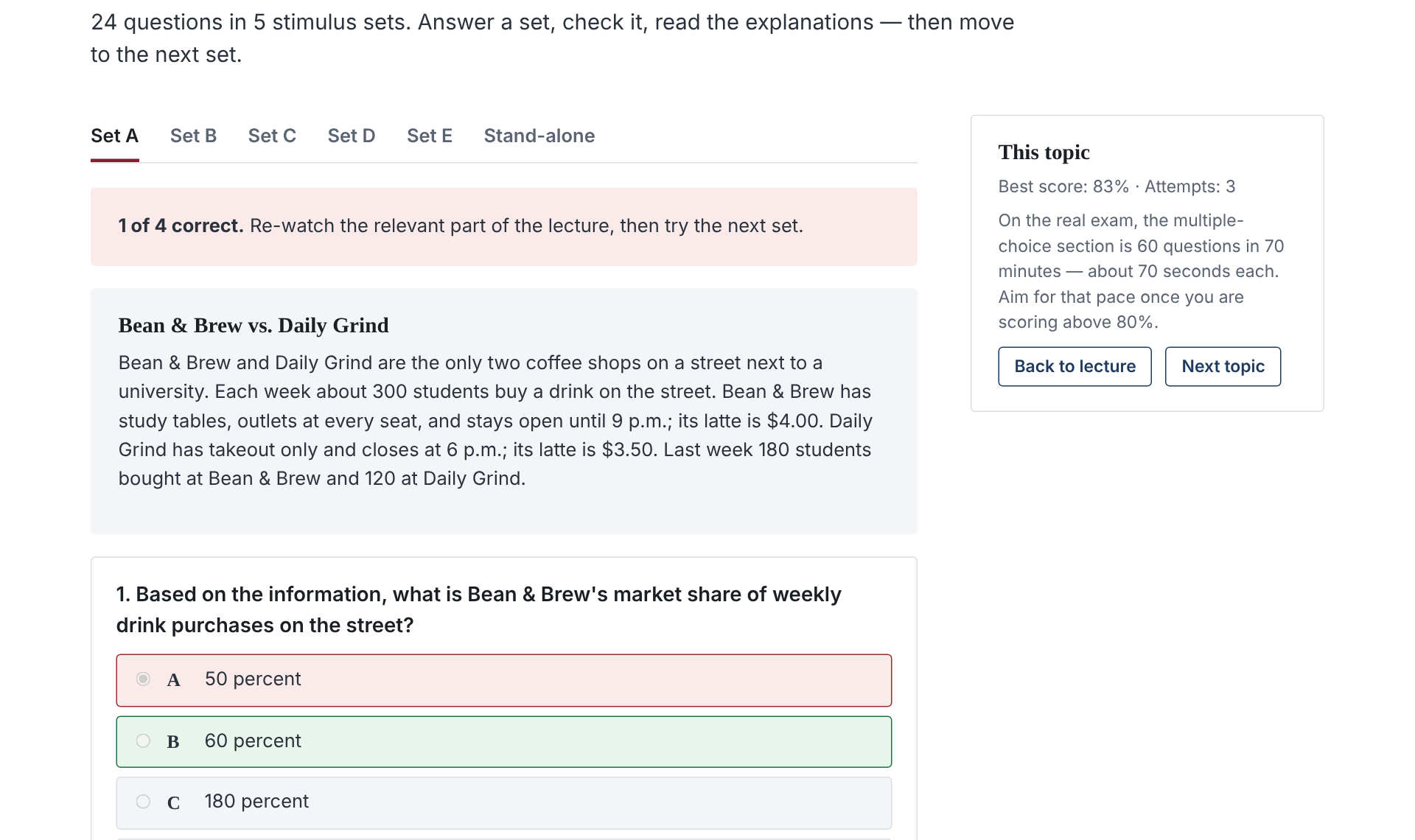
Practice sets in exam format
Stimulus-based sets, like the real paper. Check a set and every explanation names the exact knowledge statement it tests.
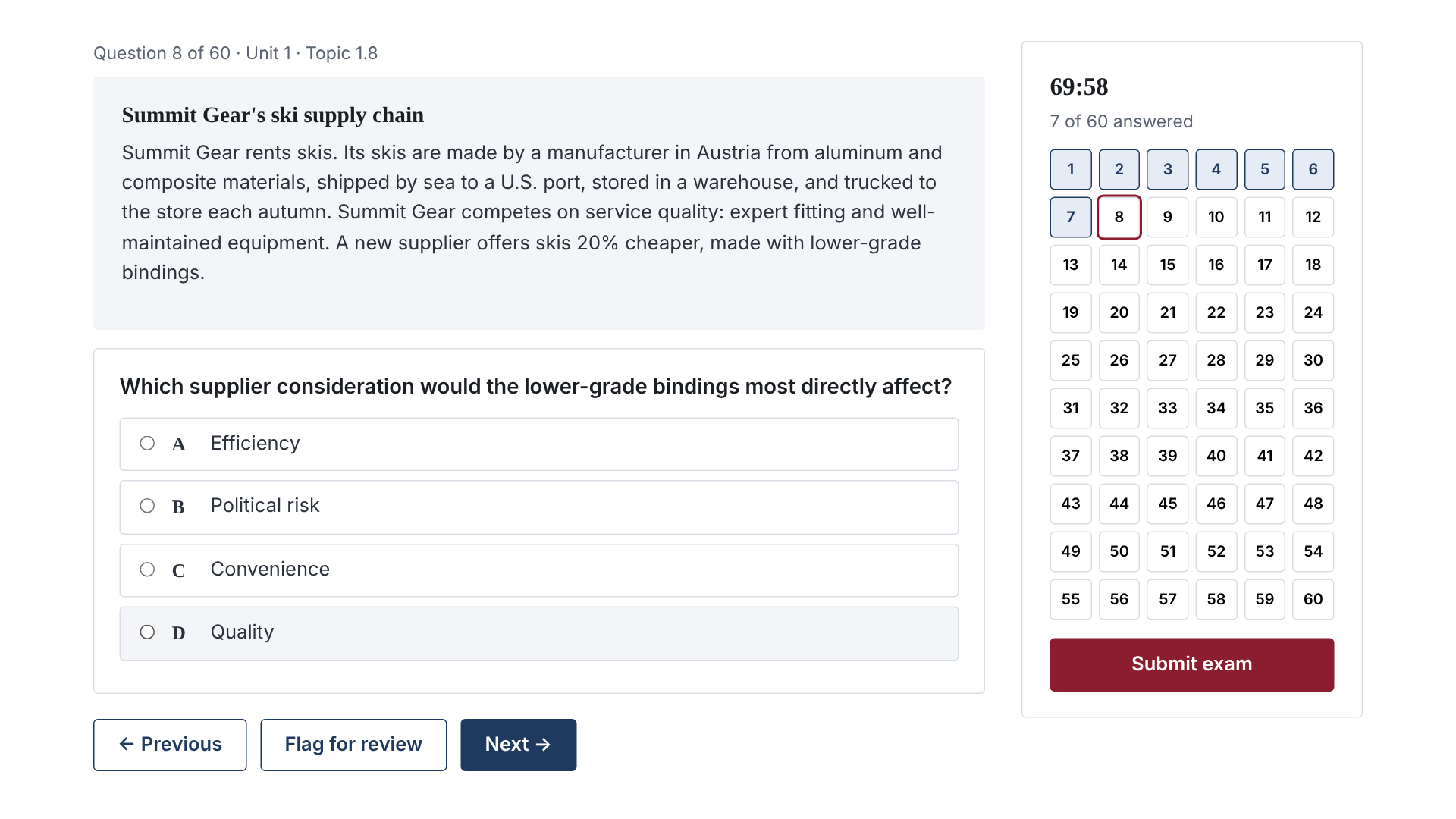
Timed mock exam
Sixty questions, seventy minutes, flag-and-return navigation. Scored by unit so you know where to go back.
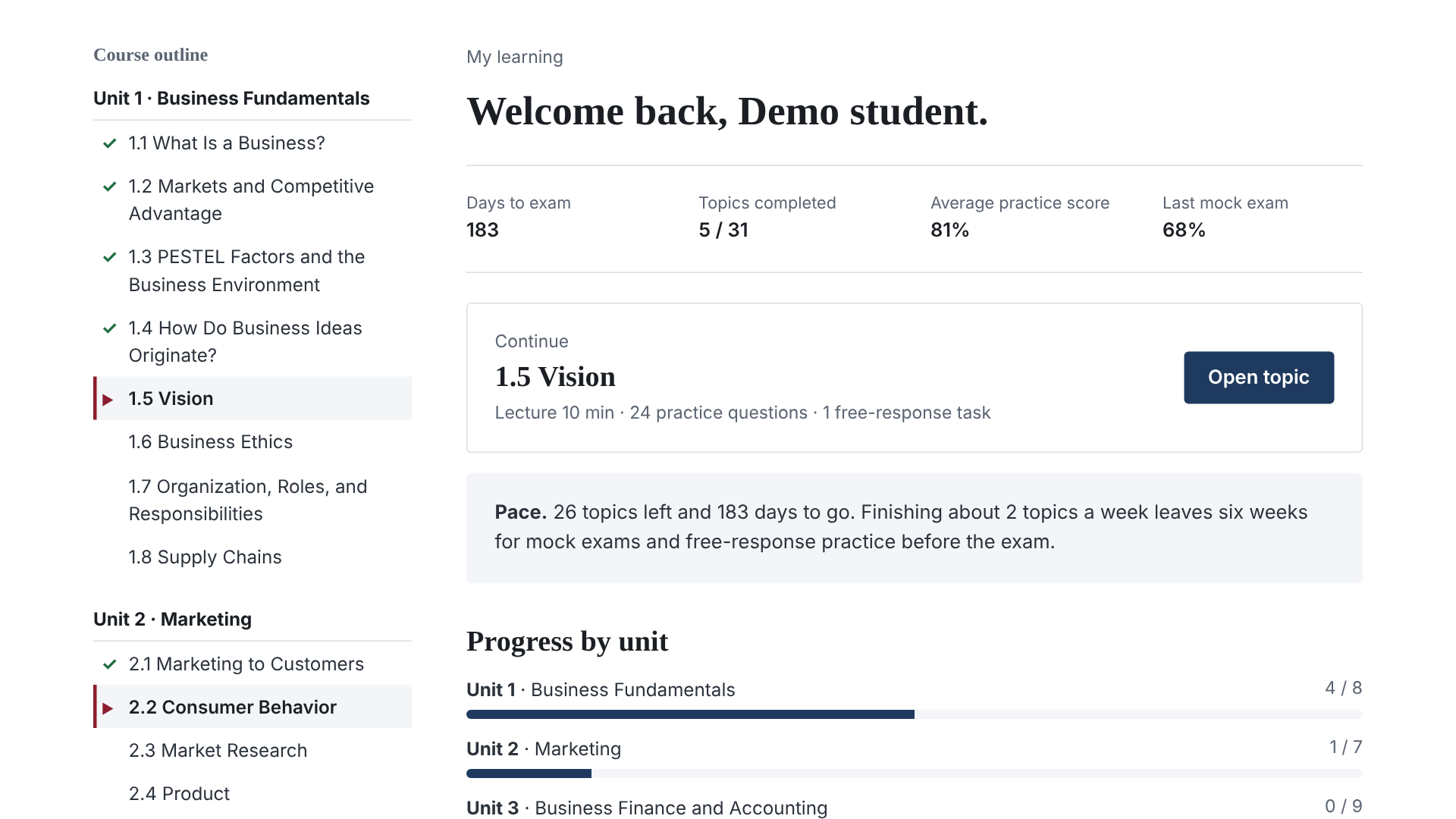
Your plan to exam day
Days left, topics done, average score, weak spots by knowledge code, and a weekly pace that leaves six weeks for review.
What free-response feedback looks like
An illustrative exchange from Topic 1.1. The task asks the student to use a research finding to achieve a business goal.
Student wrote (part C)
“Mina should use the survey to make more customers come and make the shop successful.”
Coaching
You correctly looked back at the survey — that is the right instinct. What is missing is the number and the action. Keep your idea, add both:
“Because 25% of students said they stop studying after 6 p.m., Mina should stay open until 9 p.m. with study tables, which attracts those students and lets her charge $4 for a latte that costs $1.20 to make.”
Review: value capture (price above cost), lecture scene 6. Drill: rewrite part C twice more, each time starting with a different number from the tables.
Who made this
Built by a team of consultants and executives with top-tier global MBA, McKinsey and global-company leadership backgrounds.
We built the course the way a consultant would brief a new hire: start from what the exam actually requires, teach through one real business, and check every claim.
Review before release
- Teachers running the course review lectures, practice sets and free-response rubrics for exam fit.
- MBA-trained executives at global companies review the business content for how things really work.
- Original throughout. No exam materials are copied; every question and case is ours.
Fair price, one price
Unit 1 is free. All of it.
Eight lectures, 192 practice questions, eight scored free-response tasks. Not a trial, not a teaser — the complete first unit, so you can judge the teaching before you pay anything.
Pro · $300 a year, or $35 a month
Everything, for the whole year leading to the exam: all five units, 744 questions, free-response coaching on every attempt, unlimited timed mocks, the Business Canvas workspace, and progress across devices.
Same price in every country. Full refund within 14 days of a yearly purchase if you have finished fewer than three Pro topics. Teachers running the course get Pro free.
What $300 buys elsewhere
| Option | Typical price (2026) | What $300 covers |
|---|---|---|
| Private AP® tutoring, US (online) | $50–175 per hour | About 2–6 hours |
| Private AP® tutoring, Korea (Seoul) | ₩40,000–80,000 per session | About 5–10 sessions |
| Online AP® course providers | $225–1,900 per course | Below the low end |
| TeensMBA Pro | $300 per year | 31 lectures, 744 questions, unlimited scored writing and mocks until exam day |
Market ranges from published 2026 guides: IvyStrides, AP tutoring costs · IvyStrides, online AP course costs · 미소, AP 과외 비용 (마포구). Rates vary by tutor and city; a tutor also cannot be replaced by a course for every student.
Questions parents and students ask
Is this an official College Board product? No. TeensMBA is independent. We build to the publicly available course framework and never reproduce exam materials. AP® is a registered trademark of the College Board, which does not endorse this site.
What language is it in? Lectures and questions are in English, like the exam. Korean subtitles and transcripts are included; other languages are planned as options.
Do I still need my school’s course? If your school offers it, yes — the exam includes a question about the business project you develop in class, and TeensMBA gives you a workspace and hypothesis log for exactly that. If your school does not offer it, this course covers every tested objective on its own.
I’m under 18. Can I sign up? Students 13 and over sign in with a Google or school account and start Unit 1 free. A parent or guardian makes any purchase.
How is writing scored? By an automated scorer trained on our rubrics, which mirror the exam’s 0-or-1 row scoring. It is a study aid and does not predict your official score — but it tells you, sentence by sentence, what would have earned the point.